Showing posts with label astronomy. Show all posts
Showing posts with label astronomy. Show all posts
02 January 2012
Applying to Grad School
I haven't posted here in quite some time. I've been spending more time on my LJ and Twitter accounts (try this same username both places), and works' been pretty draining for the past year. But I wanted to post that I'm applying to return to graduate school for my PhD in either physics or astronomy, with research focusing on physics education research (PER) or astronomy education research (AER), respectively.


07 July 2011
FY 2012 Congressional budget axes the James Webb Space Telescope
Bad Astronomy (Phil Plait)'s post on the subject
House Committee on Appropriations post on the subject
Write your own letter to Congress (site via the National Education Association, but you'll be writing your own content and can opt out of sending a copy to the NEA or getting on their email lists)
Model letter on the subject
Please feel free to use my letter, below, to model after for a letter to Congress. Also feel free to repose elsewhere.
House Committee on Appropriations post on the subject
Write your own letter to Congress (site via the National Education Association, but you'll be writing your own content and can opt out of sending a copy to the NEA or getting on their email lists)
Model letter on the subject
Please feel free to use my letter, below, to model after for a letter to Congress. Also feel free to repose elsewhere.
I am writing today to strongly urge you to reconsider cutting appropriations for the James Webb Space Telescope (JWST) from the FY 2012 appropriations. I am a full-time Associate Professor of Physics and Astronomy at XXX Community College, and I live and vote in your district in XXX.
With the ending of the Space Shuttle program, the US is already falling behind its international competitors and collaborators in the field of space exploration. Our two most important space observatories, the Hubble Space Telescope (HST or Hubble) and the Spitzer Space Telescope (SST or Spitzer, which operates in the infrared as will the JWST) are soon going to come to an end as well. Without the JWST to replace them, we will be even further behind.
These space-based observatories are able to observe things that no other facilities in the word (or orbiting above it) are able to do. Observatories on the ground are not able to make as sharp images or images in the infrared due to the obscuring nature of the Earth's atmosphere. Other space observatories are designed to fill different roles than Hubble and Spitzer, and the work those two space observatories perform cannot be replaced by other existing space observatories. Once they are gone and without a replacement observatory, there will not be a single nation in the world able to conduct astronomy of this sort.
In addition, all the parts of the JWST have already been manufactured and are now in the process of being assembled. At the very worst, I urge you to set aside enough money for the project to be suspended and the parts stored for later assembly while investigating the management of the project, rather than axing the JWST entirely which would necessitate disposing of the parts.
Thank you for your time reading this letter. Once again, I live and vote in your district, and I will be urging my friends and colleagues to write to their representatives as well.
30 August 2009
Mt. Wilson Observatory threatned by fire
The Mount Wilson Observatory is home to the 100-inch (2.5m) Hooker telescope, one of the most historical telescopes in the era of modern astronomy. Following on the heels of the Harvard College Observatory Computers'1 work on classifying stars, the Henry Norris Russell used the Hooker telescope, and in conjunction with Ejnar Hertzsprung developed the diagram now known as the Hertzsprung-Russell (or HR) diagram, a diagram of as much importance to astronomy as the periodic table is to chemistry. More famously, Edwin Hubble used the Hooker when he discovered the expansion of the universe, disproving the leading steady state hypothesis (even espoused by Albert Einstein). It is probably even more important that Hubble first proved that all those fuzzy "spiral nebulae" were actually entirely separate galaxies, but we take that for granted today, while cosmologists are still working on the details of the universe's expansion.
So with this background about the Mt. Wilson Observatory under your belt, perhaps you will understand some of the fear I feel when I read that as of 5:42 PDT (8:42 EDT) the LA Times was estimating that the current wildfires outside LA would probably raze the observatory within hours. As of this writing (8:57 PDT / 11:57 EDT) the fires have not yet reached the observatory (though they are visible from the observatory webcam, link is to a screenshot of the webcam since the webcam server itself is overloaded). The director of the observatory reports that firefighters will be remaining in place on Mt. Wilson overnight, implying that it is safe enough to do so, and hopefully they will be able to keep fighting and save the historic observatory.
If you the most more up-to-date information that I have been able to find, follow Mike Brown's twitter feed @plutokiller (yes, THAT Mike Brown). If the observatory does burn down overnight, I'd appreciate it if someone txted me.
1 Also referred to as "Pickering's Harem,"2 after the fact that Harvard College Observatory Director, Edward Pickering, famously stated that his male graduate students were so inept that his maid could do a better. Following on the statement, Pickering did hire his maid (Williamina Fleming) and then a string of other women, hence the unflattering name for the group. Despite the name, these human "computers" did amazing work, revolutionizing the field of stellar classification.
2 The incidence of referring to both harems and hookers in the same post is purely coincidental.
Current music: "Cold Missouri Waters" by Dar Williams, et al.
So with this background about the Mt. Wilson Observatory under your belt, perhaps you will understand some of the fear I feel when I read that as of 5:42 PDT (8:42 EDT) the LA Times was estimating that the current wildfires outside LA would probably raze the observatory within hours. As of this writing (8:57 PDT / 11:57 EDT) the fires have not yet reached the observatory (though they are visible from the observatory webcam, link is to a screenshot of the webcam since the webcam server itself is overloaded). The director of the observatory reports that firefighters will be remaining in place on Mt. Wilson overnight, implying that it is safe enough to do so, and hopefully they will be able to keep fighting and save the historic observatory.
If you the most more up-to-date information that I have been able to find, follow Mike Brown's twitter feed @plutokiller (yes, THAT Mike Brown). If the observatory does burn down overnight, I'd appreciate it if someone txted me.
1 Also referred to as "Pickering's Harem,"2 after the fact that Harvard College Observatory Director, Edward Pickering, famously stated that his male graduate students were so inept that his maid could do a better. Following on the statement, Pickering did hire his maid (Williamina Fleming) and then a string of other women, hence the unflattering name for the group. Despite the name, these human "computers" did amazing work, revolutionizing the field of stellar classification.
2 The incidence of referring to both harems and hookers in the same post is purely coincidental.
Current music: "Cold Missouri Waters" by Dar Williams, et al.
12 July 2009
Professional Ethics in Astronomy
Reposted in its entirety from an AAS email.
The AAS has drafted a statement on professional ethics on June 7, 2009 (see below). AAS members are asked to login to the AAS Forum at
http://forums.aas.org/
and provide comments. The comments will appear online after a moderator has approved them.
AAS Statement on Professional Ethics:
The mission of the American Astronomical Society is to enhance and share humanity's scientific understanding of the Universe. We believe the advancement of astronomy requires that we provide ethical guidelines for AAS members and, for that matter, anyone involved in professional astronomical activities.
Every astronomer is a citizen of the community of science. Each shares responsibility for the welfare of this community. We endorse the statement of the American Physical Society that "Science is best advanced when there is mutual trust, based upon honest behavior, throughout the community." All scientists should act ethically in the conduct of their research, in teaching and education, and in relations with both members of the public and other members of the scientific community. We have a special responsibility to students and postdocs to train them in ethical conduct.
The American Astronomical Society believes that the following are the minimal standards of ethical behavior relating to the profession.
CONDUCT TOWARDS OTHERS
All people encountered in one's professional life should be treated with respect. Discourse should be civil. Scientists should work to provide an environment that encourages the free expression and exchange of scientific ideas. They should promote equality of opportunity and treatment for all their colleagues, regardless of gender, race, ethnic origin, religion, age, marital status, sexual orientation, disabilities, or any other reason not related to scientific merit. This principle is clearly stated in our By-Laws.
More senior members of the society, especially research supervisors, have a special responsibility to facilitate the research, educational, and professional development of students and subordinates. This includes providing safe, supportive working environments, fair compensation and appropriate acknowledgment of their contribution to any research results. In addition, supervisors should encourage the timely advance of graduate students and young professionals in their career aspirations.
It is also incumbent on senior members of our society to inform more junior members of these ethical issues and of institutional and government guidelines, policies and precedures related to the oversight and maintenance of ethical standards for research and conduct. It is the responsibility of all members of our society to familiarize themselves with such guidelines, policies and procedures.
RESEARCH
It is an ethical responsiblity that research results be recorded and maintained in a form that allows review, analysis, and reproduction by others. It is incumbent on researchers involved in large, publicly-supported studies to make results available in a timely manner.
Fabrication of data or selective reporting of data with the intent to mislead or deceive is unethical and unacceptable, as is the appropriation of data or research results from others without permission and attribution.
It should be recognized that honest error is an integral part of the scientific enterprise. It is not unethical to be wrong, provided that errors are promptly acknowledged and corrected when they are detected.
PUBLICATION AND AUTHORSHIP PRACTICES
All persons who have made significant contributions to a work intended for publication should be offered the opportunity to be listed as authors. This includes all those who have contributed intellectually to the inception, design, execution, or interpretation of the research. Other individuals who have contributed to a study should be appropriately acknowledged. The sources of financial support for any project should be acknowledged/disclosed. All collaborators share responsibility for any paper they coauthor, and every coauthor should have the opportunity to review a manuscript before its submission.
Proper acknowledgement of the work of others must always be given, and complete referencing is an essential part of any astronomical research publication. Authors have an obligation to their colleagues and the scientific community to include a set of references that communicates the precedents, sources, and context of the reported work. Deliberate omission of a pertinent author or reference is unacceptable. Data provided by others must be cited appropriately, even if obtained from a public database.
All authors are responsible for providing prompt corrections or retractions if errors are found in published works.
Plagiarism is the presentation of others' words, ideas or scientific results as if they were one's own. Citations to others' work must be clear, complete, and correct. Plagiarism is unethical behavior and is never acceptable.
Authors, editors and referees should also be aware of the professional and ethical standards that have been adopted for the AAS journals ( http://aas.org/ethicsPolicy ).
PEER REVIEW
Peer review is an essential component of many aspects of the scientific process such as evaluating research proposals, publishing research results, and evaluating colleagues for career advancement.
Peer review can serve its intended function only if the members of the scientific community are prepared to provide thorough, fair, and objective evaluations based on requisite expertise. Although peer review can be difficult and time-consuming, scientists have an obligation to participate in the process.
Reviewers should disclose conflicts of interest resulting from direct competitive, collaborative, or other relationships with those they are reviewing and recuse themselves from cases where such conflicts preclude an objective evaluation. It is unethical to seek to gain an advantage by means of reviewing the work of others.
Privileged information or ideas that are obtained through peer review must be kept confidential and not used for competitive gain.
CONFLICTS OF INTEREST
Many activities of scientists and educators have the potential for a conflict of interest. Any professional relationship or action that may either be or be perceived as a conflict of interest should be fully disclosed. Most organizations or activities have mechanisms for managing conflicts, for example, through recusal. If a conflict of interest cannot be properly managed, the activity should be avoided or discontinued.
23 June 2009
The Ethics of a Mars Mission
One thing that keeps flitting into my head when we talk about a human mission to Mars, is the ethics of it. Right now we don't have the ability for anything but a one-way mission, and still I know there are people who would jump at the chance. I seem to recall reading that women astronauts are required to go on birth control, primarily to eliminate their periods, and this already seems like such an invasion of personal choice. Imagine a trip that takes 3 years each way. In a situation like this NASA really will have to take steps to prevent pregnancies, or to be able to deal with them should they happen.
The one aspect that popped into my head today though upon reading the above linked article by Buzz Aldrin is the issue of consent. The standard for experiments performed upon humans (and you can't call a trip to Mars anything but an experiment) is one of informed consent: the participants must be made aware of the risks (and the risks must be below a certain level), and the participants must give consent. Moreover, the participants have the right to with draw consent at any point in time. Missions on the ISS and such are already seriously pushing the boundaries on this one IMO (does the screening of astronauts beforehand allow NASA to get around the ethics board? or is NASA not subject to an ethics board?). How much more questionable in terms of withdrawing consent is a round trip to Mars? What about a colonization trip?
On the other hand, the worry about consent is another incentive for mandatory birth control and/or sterilization: children are unable to give consent, and it would be unethical to put an infant into the situation of a trip to Mars. I wonder at what point in colonization we will determine it is safe enough to allow children. And will the requirements be different for children transported to the colony vs. children produced in situ?
The one aspect that popped into my head today though upon reading the above linked article by Buzz Aldrin is the issue of consent. The standard for experiments performed upon humans (and you can't call a trip to Mars anything but an experiment) is one of informed consent: the participants must be made aware of the risks (and the risks must be below a certain level), and the participants must give consent. Moreover, the participants have the right to with draw consent at any point in time. Missions on the ISS and such are already seriously pushing the boundaries on this one IMO (does the screening of astronauts beforehand allow NASA to get around the ethics board? or is NASA not subject to an ethics board?). How much more questionable in terms of withdrawing consent is a round trip to Mars? What about a colonization trip?
On the other hand, the worry about consent is another incentive for mandatory birth control and/or sterilization: children are unable to give consent, and it would be unethical to put an infant into the situation of a trip to Mars. I wonder at what point in colonization we will determine it is safe enough to allow children. And will the requirements be different for children transported to the colony vs. children produced in situ?
20 April 2009
"Training the Next Generation of Astronomers"
An interesting article on how future astronomers are being trained, this article makes a few key points on the current process. (Full text available for free via the download links.)
For example, the current generation of grad students are being trained to perform research, when in reality most astronomers do not spend the majority of their time actually performing research. Most researchers instead are managers, grant writers, and are in charge of budgets, none of which are skills we learn as grad students.
In addition 11% of PhD earning astronomers go into EPO (Education and Public Outreach) careers, and many researchers also perform some component of EPO as well. Without EPO, the public would not have such a love for astronomy, congress wouldn't fund NASA nearly as much, and even the HST would have been retired a decade ago.
A large portion of the paper is also dedicated to the family unfriendliness of academia, making the point that this doesn't hurt only women, but also those men who wish to play a larger role in their families.
Give the article a read!
For example, the current generation of grad students are being trained to perform research, when in reality most astronomers do not spend the majority of their time actually performing research. Most researchers instead are managers, grant writers, and are in charge of budgets, none of which are skills we learn as grad students.
In addition 11% of PhD earning astronomers go into EPO (Education and Public Outreach) careers, and many researchers also perform some component of EPO as well. Without EPO, the public would not have such a love for astronomy, congress wouldn't fund NASA nearly as much, and even the HST would have been retired a decade ago.
A large portion of the paper is also dedicated to the family unfriendliness of academia, making the point that this doesn't hurt only women, but also those men who wish to play a larger role in their families.
Give the article a read!
27 March 2009
Today Show on MSNBC screws up Equinox
As usual a news show tries to trump up how the Equinox is the only time you can balance an egg on end. This is entirely untrue, debunked by Phil Plait here and here. But that's not the fun part of the below video.
Visit msnbc.com for Breaking News, World News, and News about the Economy
22 March 2009
Belt of Venus
On an evening flight from Minnesota to Connecticut Friday evening, I finally saw the Belt of Venus for the first time. I didn't have my camera handy and photos through windows never come out well anyway, so here's a photo from a Google search:

The Belt of Venus is actually the Earth's own shadow cast in the sky. As you probably already know, the bright blue of the daytime sky is due to light from the Sun being scattered by dust in the atmosphere. When you take away that light from the Sun, what you're left with is a dark sky. The Belt of Venus appears on the Eastern horizon just after the Sun is sets in the West because the sunlight doesn't reach the Eastern horizon at that time. This is also why I suspect I haven't ever seen it previously - too high a horizon all around me where I live.
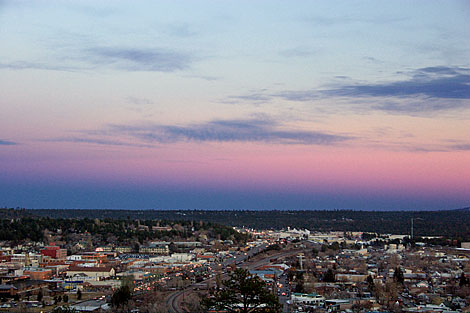
The Belt of Venus is actually the Earth's own shadow cast in the sky. As you probably already know, the bright blue of the daytime sky is due to light from the Sun being scattered by dust in the atmosphere. When you take away that light from the Sun, what you're left with is a dark sky. The Belt of Venus appears on the Eastern horizon just after the Sun is sets in the West because the sunlight doesn't reach the Eastern horizon at that time. This is also why I suspect I haven't ever seen it previously - too high a horizon all around me where I live.
14 January 2009
08 January 2009
What is Science?
I'm working on creating an online course that is the equivalent of my face-to-face intro astronomy course. Think of it as an "astronomy for poets" course, as there's very little math, and it's an overview course. Below is the first online lecture for it, or if the embedding doesn't work well for you, here's the direct link.
04 January 2009
Mercury Falling
Look for Mercury tonight in the West after sunset. Jupiter will appear moderately bright and very close to the horizon. Venus will be brighter and higher in the sky to the South-West. And Mercury will be fainter near Jupiter, for about an hour after sunset. Make sure to find a low western horizon, or you won't see this at all.
I have yet to spot Mercury myself in the night sky, so I'm really hoping it stays clear tonight!
I have yet to spot Mercury myself in the night sky, so I'm really hoping it stays clear tonight!
01 January 2009
24 December 2008
Calendric woes
We're having a leap second this year at New Year's. The atomic clocks will briefly read "11:59:60 pm" (after reading "11:59:59 pm") Dec 31, before finally rolling over to 12:00:00 am, January 1.
One of my close high school friends says her birthday is the Ides of March (March 15), but it's really the 15th day of the 3rd month in the Chinese calendar. She was born in China, in the third month of their calendar, on the 15th day of that calendar, so when they emigrated they put down our third month (March) and 15th day (March 15, the Ides of March, per Julius Caesar fame). However, the luni-solar calendar doesn't start on our January 1, it starts (IIRC) two New Moons after Winter Solstice - which is usually early February or occasionally late January. So the date she was born according to the Western solar calendar (what we use in the USA) was "actually" sometime around early April through mid May. What date her Chinese birthday falls on will then vary every year, since our calendars are not in sync. Hence the simplicity of just saying it's the Ides of March every year.
And if you got that explanation of mine, try out this explanation of when Sir Isaac Newton's birthday should be.
One of my close high school friends says her birthday is the Ides of March (March 15), but it's really the 15th day of the 3rd month in the Chinese calendar. She was born in China, in the third month of their calendar, on the 15th day of that calendar, so when they emigrated they put down our third month (March) and 15th day (March 15, the Ides of March, per Julius Caesar fame). However, the luni-solar calendar doesn't start on our January 1, it starts (IIRC) two New Moons after Winter Solstice - which is usually early February or occasionally late January. So the date she was born according to the Western solar calendar (what we use in the USA) was "actually" sometime around early April through mid May. What date her Chinese birthday falls on will then vary every year, since our calendars are not in sync. Hence the simplicity of just saying it's the Ides of March every year.
And if you got that explanation of mine, try out this explanation of when Sir Isaac Newton's birthday should be.
30 October 2008
Outside the Universe?
One of my friends over on LiveJournal asked what's outside the universe. Thought it'd be fun to post my response here and see what y'all think.
The current model of the universe says that there isn't an "outside" to it in that if you keep going in one direction you can "leave" the universe. It's like if you look at a map of the Earth and ask what's past the edge - the Earth is round so you just come back to the other side of it. We're not convinced that our universe is finite in size (and therefore loops back on itself) or if it's instead infinite.
However, when you look at the flat map of the Earth, what that map fails to show is that since the Earth is a sphere, you *can* leave the Earth. If you could leave the universe, our best guess right now (via string theory) is that there are multiple "higher dimensional" universes called branes (short for membranes) that intersect to form universes like ours. So if we had hyperdimensional eyes, we'd see a bunch of sheets that cross each other, and at each crossing is another universe. I'm not sure if this idea is testable yet, or if it's still just a pipe dream though.
29 October 2008
iPhone Astronomy
iPhone-based astrophotography is begun. Below is an image of Jupiter taken by an iPhone through an 8" Meade Cassegrain telescope by amateur astronomer Mike Weasner.

Note that on the right you can see three of the moons of Jupiter - this is similar to what Galileo saw when looking through his small 2" refracting telescope, hence the four largest moons are dubbed the Galilean moons in his honor. Continued observations of Jupiter over the course of days, months, and even years led Galileo to the realization that they were orbiting Jupiter, not the Earth, and therefore the Earth was not the center of the universe.
Another thing you can see in this image is that the face of Jupiter has bands across it. Galileo could not see these himself, but he saw other "irregularities" or deviations from perfection on the Moon (craters), Saturn (rings, which he couldn't identify as such), and Venus (phases, like we see our Moon go through naked-eye). These other features also helped support Galileo's claim that the universe was NOT perfect, and did NOT revolve around the Earth. Rest assured if he had seen stripes on Jupiter, he would have recorded such a fact.
So this little iPhone image is better than what the father of modern astronomy saw himself.
For more information on this image and the telescope used, see also:
* Bad Astronomy (Dr. Phil Plait)
* The Mac Observer (John Martellaro)
* Weasner's Mighty ETX Site (Mike Weasner)
* Meade Telescopes, LX200-ACF model
Note that on the right you can see three of the moons of Jupiter - this is similar to what Galileo saw when looking through his small 2" refracting telescope, hence the four largest moons are dubbed the Galilean moons in his honor. Continued observations of Jupiter over the course of days, months, and even years led Galileo to the realization that they were orbiting Jupiter, not the Earth, and therefore the Earth was not the center of the universe.
Another thing you can see in this image is that the face of Jupiter has bands across it. Galileo could not see these himself, but he saw other "irregularities" or deviations from perfection on the Moon (craters), Saturn (rings, which he couldn't identify as such), and Venus (phases, like we see our Moon go through naked-eye). These other features also helped support Galileo's claim that the universe was NOT perfect, and did NOT revolve around the Earth. Rest assured if he had seen stripes on Jupiter, he would have recorded such a fact.
So this little iPhone image is better than what the father of modern astronomy saw himself.
For more information on this image and the telescope used, see also:
* Bad Astronomy (Dr. Phil Plait)
* The Mac Observer (John Martellaro)
* Weasner's Mighty ETX Site (Mike Weasner)
* Meade Telescopes, LX200-ACF model
27 October 2008
Stephen Hawking to retire
Stephen Hawking is facing a mandatory retirement clause at Cambridge University at the end of the year. But we all know that good physicists don't ever quit, they just go emeritus, stop teaching, and do research full time.
19 October 2008
Hubble Update
NASA has started the switchover process to Side B - it turns out I was a bit fuzzy in my understanding before. The two "sides" are not the power source, they're computers that interpret commands from Mission Control, and send data back down to the ground. Either way, Hubble can't take any data while this equipment is down. Because it's actually a computer, and the process of switching from one to the other is complex, they haven't tested Side B since it was launched - why mess with a good thing as long as Side A was working. So during the process of switching over, they hit a snag, though they haven't detailed what the problem is. Time will tell how easily they'll fix it. At the worst, the next Shuttle Servicing (I think it's scheduled for February?) could bring a whole new "side" up and fix the problems.
In the meantime, many astronomers are losing their time on the Hubble. It's my understanding that if you lose your time, you have to reapply for more time in the future, but you tend to get a high priority if that's the case. (This is a similar process to how it works if you're on a land-based telescope and you get clouded out.) There are a few projects that have guaranteed time, and they essentially get a percentage of the functional HST time, so for any time that the HST is down they just lose their time. The people/institutions who "own" that time can choose to reschedule as they wish.
In the meantime, many astronomers are losing their time on the Hubble. It's my understanding that if you lose your time, you have to reapply for more time in the future, but you tend to get a high priority if that's the case. (This is a similar process to how it works if you're on a land-based telescope and you get clouded out.) There are a few projects that have guaranteed time, and they essentially get a percentage of the functional HST time, so for any time that the HST is down they just lose their time. The people/institutions who "own" that time can choose to reschedule as they wish.
13 October 2008
IR Photography
This weekend I was playing around with an infrared filter on my digital camera, and realized that the resulting photos could help illustrate some points in astronomy.
Different types of light are important in astronomy, as they are tracers for different processes and temperatures inside the objects we're looking at. Since we can never go to most of the objects we study, it's crucial that we get as much information as we can from light alone. For example, IR light is good for studying cold objects, and for studying objects that are hidden inside a cloud of dust.
Take a look at the three photos below. They are (in order) normal visible light as our eyes see it, a black and white version of what our eyes normally see (visible light), and an infrared image (displayed in black and white). (Click on the images for bigger versions.)


Notice how in the last image, the water and the sky appear darker. This means that they are not sending as much IR light towards the camera as they are sending visible light. Specifically, this is the same reason as the sky is blue: light from the Sun comes in all colors. Red light (and infrared light) tends to go straight through the Earth's atmosphere. Blue light, however, gets scattered by dust in the air, so as a result the whole sky looks blue. Since the red light goes straight through, this is also why at sunset the Sun looks red. Since the IR light goes straight through as well, when we look at the sky in IR light, we do not see the IR light from the Sun scattered throughout the sky, so the sky looks dark. Lakes look bright blue because the blue light of the sky is then reflected back at our eyes, so in IR lakes and rivers would also appear dark. Note however, that the clouds on the horizon of the IR image do appear bright - the high water content in these clouds does scatter the IR light back towards the camera.
Similarly, IR light goes right through thin clouds in space (just like it goes through our atmosphere), but it does eventually get stopped by thicker clouds (just like the clouds on the horizon in the last image). Because of this, we have to use radio waves to see through the densest clouds. And also because of the clouds and moisture on Earth, we cannot actually do sensitive IR imagery from the ground, and have to instead do it from very high mountaintop observatories (above much of the Earth's atmosphere), or from space telescopes like Spitzer.
Different types of light are important in astronomy, as they are tracers for different processes and temperatures inside the objects we're looking at. Since we can never go to most of the objects we study, it's crucial that we get as much information as we can from light alone. For example, IR light is good for studying cold objects, and for studying objects that are hidden inside a cloud of dust.
Take a look at the three photos below. They are (in order) normal visible light as our eyes see it, a black and white version of what our eyes normally see (visible light), and an infrared image (displayed in black and white). (Click on the images for bigger versions.)
Notice how in the last image, the water and the sky appear darker. This means that they are not sending as much IR light towards the camera as they are sending visible light. Specifically, this is the same reason as the sky is blue: light from the Sun comes in all colors. Red light (and infrared light) tends to go straight through the Earth's atmosphere. Blue light, however, gets scattered by dust in the air, so as a result the whole sky looks blue. Since the red light goes straight through, this is also why at sunset the Sun looks red. Since the IR light goes straight through as well, when we look at the sky in IR light, we do not see the IR light from the Sun scattered throughout the sky, so the sky looks dark. Lakes look bright blue because the blue light of the sky is then reflected back at our eyes, so in IR lakes and rivers would also appear dark. Note however, that the clouds on the horizon of the IR image do appear bright - the high water content in these clouds does scatter the IR light back towards the camera.
Similarly, IR light goes right through thin clouds in space (just like it goes through our atmosphere), but it does eventually get stopped by thicker clouds (just like the clouds on the horizon in the last image). Because of this, we have to use radio waves to see through the densest clouds. And also because of the clouds and moisture on Earth, we cannot actually do sensitive IR imagery from the ground, and have to instead do it from very high mountaintop observatories (above much of the Earth's atmosphere), or from space telescopes like Spitzer.
05 October 2008
MESSENGER flies by Mercury tonight
MESSENGER, the latest mission to Mercury, makes its second fly-by of the planet tonight. Keep your eyes peeled for articles online with the new pictures in the morning!
Let's see what the astrologers have to say about this one (considering that Mercury's in retrograde, yadda yadda).
Let's see what the astrologers have to say about this one (considering that Mercury's in retrograde, yadda yadda).
05 September 2008
C-14 anomalies and solar fluctuation
So you know how you learned in high school about carbon dating be a super reliable way of measuring the age of things, since the amount of C-14 in organic material decreases at a steady rate?
They lied.
The amount of (mildly) radioactive Carbon-14 in organic materials does slowly decrease. But exactly how slowly or quickly depends upon two additional factors: how much C-14 is present in the atmosphere around that sample, and how much the C-14 is also triggered to decay. And fascinatingly, it turns out that the Sun of all things influences both of those!
Specifically the Sun's neutrino output. Neutrinos are high energy but low mass particles that the Sun creates in the process of nuclear fusion. When these particles collide with Nitrogen-14 in the atmosphere, they cause the N-14 to convert to C-14. Therefore if there's more neutrinos coming out from the Sun than usual, we'll have more C-14 than usual, so C-14 will appear to decay more slowly than usual, so in order to get a large amount of decay we'd need a super-large amount of time, so (if we assumed it was decaying at the same rate as usual) we would be estimating times too short.
On the other hand, there's a competing effect too. C-14 naturally decays, however it can be stimulated to decay faster, and in fact neutrinos can do this too. So if htere's more neutrinos coming from the Sun, C-14 will be decaying faster than usual, so to get a large amount of decay we'd need only a small amount of time, so (if we assumed it was decaying at the same rate as usual) we would be estimating times too long.
Now here's what's interesting. If we compare the ages of trees based upon carbon dating to their ages based upon tree rings, we can try and calibrate the rate of C-14 decay to what's really happening. While the authors of the linked paper didn't specify which of the two effects dominated (that is, it's unclear to me if excess neutrinos would result in MORE or LESS C-14 overall, and thus over- or underestimate the ages of trees using C-14), they did say that there's a 200-year period to the "anomalies" in carbon-dating results as compared to tree rings. So if the anomalies are caused by the Sun's neutrino output, that means that the Sun's nuclear fusion (which creates the neutrinos) is varying on a 200-year cycle.
Why hello, Mr. Variable Star!
They lied.
The amount of (mildly) radioactive Carbon-14 in organic materials does slowly decrease. But exactly how slowly or quickly depends upon two additional factors: how much C-14 is present in the atmosphere around that sample, and how much the C-14 is also triggered to decay. And fascinatingly, it turns out that the Sun of all things influences both of those!
Specifically the Sun's neutrino output. Neutrinos are high energy but low mass particles that the Sun creates in the process of nuclear fusion. When these particles collide with Nitrogen-14 in the atmosphere, they cause the N-14 to convert to C-14. Therefore if there's more neutrinos coming out from the Sun than usual, we'll have more C-14 than usual, so C-14 will appear to decay more slowly than usual, so in order to get a large amount of decay we'd need a super-large amount of time, so (if we assumed it was decaying at the same rate as usual) we would be estimating times too short.
On the other hand, there's a competing effect too. C-14 naturally decays, however it can be stimulated to decay faster, and in fact neutrinos can do this too. So if htere's more neutrinos coming from the Sun, C-14 will be decaying faster than usual, so to get a large amount of decay we'd need only a small amount of time, so (if we assumed it was decaying at the same rate as usual) we would be estimating times too long.
Now here's what's interesting. If we compare the ages of trees based upon carbon dating to their ages based upon tree rings, we can try and calibrate the rate of C-14 decay to what's really happening. While the authors of the linked paper didn't specify which of the two effects dominated (that is, it's unclear to me if excess neutrinos would result in MORE or LESS C-14 overall, and thus over- or underestimate the ages of trees using C-14), they did say that there's a 200-year period to the "anomalies" in carbon-dating results as compared to tree rings. So if the anomalies are caused by the Sun's neutrino output, that means that the Sun's nuclear fusion (which creates the neutrinos) is varying on a 200-year cycle.
Why hello, Mr. Variable Star!
Subscribe to:
Posts (Atom)


