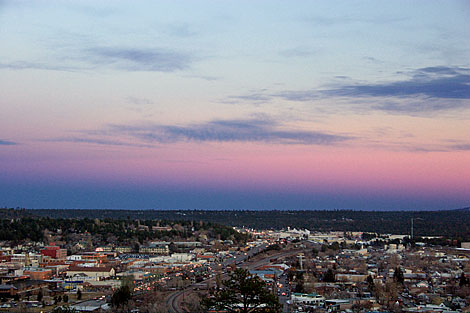
The Belt of Venus is actually the Earth's own shadow cast in the sky. As you probably already know, the bright blue of the daytime sky is due to light from the Sun being scattered by dust in the atmosphere. When you take away that light from the Sun, what you're left with is a dark sky. The Belt of Venus appears on the Eastern horizon just after the Sun is sets in the West because the sunlight doesn't reach the Eastern horizon at that time. This is also why I suspect I haven't ever seen it previously - too high a horizon all around me where I live.
Showing posts with label sky watching. Show all posts
22 March 2009
Belt of Venus
On an evening flight from Minnesota to Connecticut Friday evening, I finally saw the Belt of Venus for the first time. I didn't have my camera handy and photos through windows never come out well anyway, so here's a photo from a Google search:

The Belt of Venus is actually the Earth's own shadow cast in the sky. As you probably already know, the bright blue of the daytime sky is due to light from the Sun being scattered by dust in the atmosphere. When you take away that light from the Sun, what you're left with is a dark sky. The Belt of Venus appears on the Eastern horizon just after the Sun is sets in the West because the sunlight doesn't reach the Eastern horizon at that time. This is also why I suspect I haven't ever seen it previously - too high a horizon all around me where I live.
04 January 2009
Mercury Falling
Look for Mercury tonight in the West after sunset. Jupiter will appear moderately bright and very close to the horizon. Venus will be brighter and higher in the sky to the South-West. And Mercury will be fainter near Jupiter, for about an hour after sunset. Make sure to find a low western horizon, or you won't see this at all.
I have yet to spot Mercury myself in the night sky, so I'm really hoping it stays clear tonight!
Subscribe to:
Posts (Atom)
