25 May 2009

North Korea's nuclear bomb test

I'm not a big fan of politics, but part of the story about North Korea's second nuclear bomb test caught my eye.

North Korea announced its underground nuclear test a little more than an hour after the U.S. Geological Survey reported a magnitude 4.7 seismic disturbance at the site of North Korea's first nuclear test. --CNN


And sure enough, here's the earthquake data from the USGS.

04 May 2009

Strike Two for California

A California high school history teacher has been found guilty of violating the First Amendment by calling a student's comments about creationism "religious, superstitious nonsense". Ouch! It gets worse.

In a December 2007 lawsuit, [Advanced Placement European history student, Chad] Farnan, then a sophomore, accused Corbett of repeatedly promoting hostility toward Christians in class and advocating "irreligion over religion" in violation of the First Amendment's establishment clause.

The establishment clause prohibits the government from making any law "respecting an establishment of religion" and has been interpreted by U.S. courts to also prohibit government employees from displaying religious hostility. --Scott Martindale, The Orange County Register


So government employees are not allowed to talk about non-religious alternatives.

It gets worse.

Corbett made his "superstitious nonsense" remark during a class discussion about a 1993 court case in which former Capistrano Valley High science teacher John Peloza sued the Capistrano Unified School District, challenging its requirement that Peloza teach evolution. --Scott Martindale, The Orange County Register


So yes, this comment really was in the context of a conversation about evolution and creationism. I will admit that how the teacher said it is quite disrespectful, but to call it the "establishment of (ir)religion?!" Are teachers not allowed to express personal opinion? The court found the school district not liable for the teacher's comments, so clearly this was the teacher's opinion, so if it was just his opinion how does it constitute the government establishing, because that's what the first amendment is about, the government And if it's the government doing the establishing, why is it the teacher is the defendant, and not the government?

And the part that I fear the most: does this mean my telling my science students that creationism is "not a scientific statement" is also violating the freedom of speech and separation of Church and State? Should I wipe my lecture on the origins of life on Earth in the context of astrobiology in the fear that a student will charge me with something?

This is just ridiculous.

20 April 2009

"Training the Next Generation of Astronomers"

An interesting article on how future astronomers are being trained, this article makes a few key points on the current process. (Full text available for free via the download links.)

For example, the current generation of grad students are being trained to perform research, when in reality most astronomers do not spend the majority of their time actually performing research. Most researchers instead are managers, grant writers, and are in charge of budgets, none of which are skills we learn as grad students.

In addition 11% of PhD earning astronomers go into EPO (Education and Public Outreach) careers, and many researchers also perform some component of EPO as well. Without EPO, the public would not have such a love for astronomy, congress wouldn't fund NASA nearly as much, and even the HST would have been retired a decade ago.

A large portion of the paper is also dedicated to the family unfriendliness of academia, making the point that this doesn't hurt only women, but also those men who wish to play a larger role in their families.

Give the article a read!

27 March 2009

Today Show on MSNBC screws up Equinox

As usual a news show tries to trump up how the Equinox is the only time you can balance an egg on end. This is entirely untrue, debunked by Phil Plait here and here. But that's not the fun part of the below video.

25 March 2009

Appeal to Authority

Logical fallacies are viewpoints brought up during arguments which appear logical on the surface, but when you dig a little deeper are in fact mostly unfounded. One common fallacy is the appeal to authority, where you assume that just because someone is an "authority," that they have to be right. For example, "Pope Urban VIII said that Galileo's views were wrong, so since I trust the Pope I'm going to agree with the Pope and say that the universe is actually geocentric." Sometimes the flaw is that the "authority" isn't actually authoritative in the topic in question - the Pope isn't an astronomer, the President of the US isn't a meteorologist, etc. But even if the "authority" is actually an authority, that doesn't make him/her automatically correct. Even authorities make mistakes - look at Tycho Brahe for example. This is also the entire point of peer reviewed journals, to give the authorities the chance to duke it out.

So that said, when the NY Times Magazine devotes a 28-screen-long article to singing Freeman Dyson's laurels as a motivation for us to listen to his arguments about CO_2 levels, I find myself quite disappointed. Dyson is an authority on quantum physics and sci-fi concepts (such as the Dyson sphere, which led to Larry Niven's Ringworld concept/series); he is NOT an authority on environmental science. I don't care how many people think he's a genius, he isn't a genius in this field. And even if he were, even authorities can make mistakes. It is NOT appropriate for the NY Times to promote an individual's ideas based solely upon that individual's reputation. If the article were billing itself as a biography of Dyson's life, it could be an excellent one, but the article is trying to give us a view of Dyson's ideas and as such it is a remarkably poor one.

I guess in the end by expecting the NY Times to live up to its reputation, I too am guilty of putting too much faith in authority.

22 March 2009

Belt of Venus

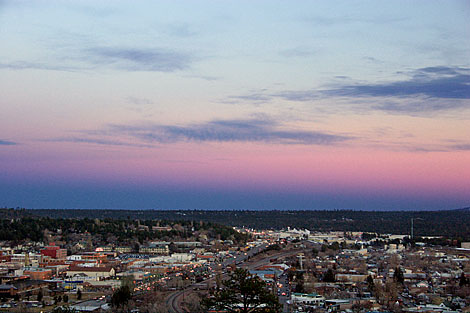
On an evening flight from Minnesota to Connecticut Friday evening, I finally saw the Belt of Venus for the first time. I didn't have my camera handy and photos through windows never come out well anyway, so here's a photo from a Google search:


The Belt of Venus is actually the Earth's own shadow cast in the sky. As you probably already know, the bright blue of the daytime sky is due to light from the Sun being scattered by dust in the atmosphere. When you take away that light from the Sun, what you're left with is a dark sky. The Belt of Venus appears on the Eastern horizon just after the Sun is sets in the West because the sunlight doesn't reach the Eastern horizon at that time. This is also why I suspect I haven't ever seen it previously - too high a horizon all around me where I live.

17 March 2009

Texas BOE to vote on Science Standards again

Once again Texas has reviewed and revised its state science standards, and once again they're trying to put in creationism. In this instance it's particularly bad because textbooks for the largest state in the US will be selected based upon these standards. If this bothers you, especially if you live in Texas yourself, here's some info on who to contact to complain and bring some sanity back into the process.