Logical fallacies are viewpoints brought up during arguments which appear logical on the surface, but when you dig a little deeper are in fact mostly unfounded. One common fallacy is the appeal to authority, where you assume that just because someone is an "authority," that they have to be right. For example, "Pope Urban VIII said that Galileo's views were wrong, so since I trust the Pope I'm going to agree with the Pope and say that the universe is actually geocentric." Sometimes the flaw is that the "authority" isn't actually authoritative in the topic in question - the Pope isn't an astronomer, the President of the US isn't a meteorologist, etc. But even if the "authority" is actually an authority, that doesn't make him/her automatically correct. Even authorities make mistakes - look at Tycho Brahe for example. This is also the entire point of peer reviewed journals, to give the authorities the chance to duke it out.
So that said, when the NY Times Magazine devotes a 28-screen-long article to singing Freeman Dyson's laurels as a motivation for us to listen to his arguments about CO_2 levels, I find myself quite disappointed. Dyson is an authority on quantum physics and sci-fi concepts (such as the Dyson sphere, which led to Larry Niven's Ringworld concept/series); he is NOT an authority on environmental science. I don't care how many people think he's a genius, he isn't a genius in this field. And even if he were, even authorities can make mistakes. It is NOT appropriate for the NY Times to promote an individual's ideas based solely upon that individual's reputation. If the article were billing itself as a biography of Dyson's life, it could be an excellent one, but the article is trying to give us a view of Dyson's ideas and as such it is a remarkably poor one.
I guess in the end by expecting the NY Times to live up to its reputation, I too am guilty of putting too much faith in authority.
25 March 2009


22 March 2009
Belt of Venus
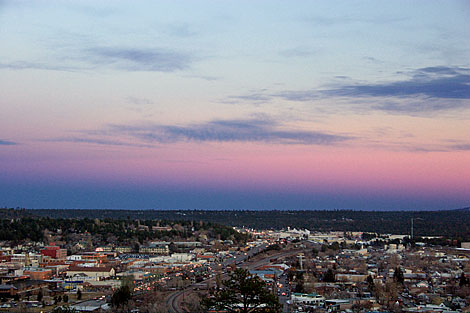
On an evening flight from Minnesota to Connecticut Friday evening, I finally saw the Belt of Venus for the first time. I didn't have my camera handy and photos through windows never come out well anyway, so here's a photo from a Google search:

The Belt of Venus is actually the Earth's own shadow cast in the sky. As you probably already know, the bright blue of the daytime sky is due to light from the Sun being scattered by dust in the atmosphere. When you take away that light from the Sun, what you're left with is a dark sky. The Belt of Venus appears on the Eastern horizon just after the Sun is sets in the West because the sunlight doesn't reach the Eastern horizon at that time. This is also why I suspect I haven't ever seen it previously - too high a horizon all around me where I live.
The Belt of Venus is actually the Earth's own shadow cast in the sky. As you probably already know, the bright blue of the daytime sky is due to light from the Sun being scattered by dust in the atmosphere. When you take away that light from the Sun, what you're left with is a dark sky. The Belt of Venus appears on the Eastern horizon just after the Sun is sets in the West because the sunlight doesn't reach the Eastern horizon at that time. This is also why I suspect I haven't ever seen it previously - too high a horizon all around me where I live.
17 March 2009
Texas BOE to vote on Science Standards again
Once again Texas has reviewed and revised its state science standards, and once again they're trying to put in creationism. In this instance it's particularly bad because textbooks for the largest state in the US will be selected based upon these standards. If this bothers you, especially if you live in Texas yourself, here's some info on who to contact to complain and bring some sanity back into the process.
13 March 2009
Do we know basic science?
Unfortunately the answer is No. It's predictable that 31% of US adults surveyed said that dinosaurs and humans lived at the same time - thank you religious right! What's less comprehensible is that 47% didn't know the amount of time it takes the Earth to go around the Sun. IT'S A YEAR - THAT'S WHY WE HAVE THE YEAR IN THE FIRST PLACE.
Despite this complete ignorance, around 80% said that basic scientific research and education are important. Just not important enough for them to know any of it.
Despite this complete ignorance, around 80% said that basic scientific research and education are important. Just not important enough for them to know any of it.
12 March 2009
"The Fair Copyright in Research Works Act"
The Fair Copyright in Research Works Act is supposedly intended to protect the intellectual property of scientists and their funding sources. Right now the NIH requires that all research funded by them be made available to the public for free after a certain proprietary period (in addition to their usual publication in peer-reviewed journals). Passing the bill would allow the NIH (and other federal groups such as the NSF, etc.) to remove this requirement from federally funded researchers, so that the researchers could choose to (or additional private funding sources could require them to) only publish their work in expensive peer-reviewed journals.
There is some debate about whether this is really as bad as it sounds. On the one hand, it sounds like the Act would allow the stifling of scientific communications and would mean that the American public would have to pay twice to see the work that their taxes paid for. On the other hand, it's my understanding that all federally funded research is required to be public domain and it's not clear that this Act would counteract that, or that the NIH and other federal groups would choose to do what the Act would allow. In addition, it might allow researchers to use multiple funding sources for a project which they may be unable to do right now - pharmaceutical companies may require NDAs for their work which the NIH regulations currently rule out since the researchers have to publish publicly.
Some links for more reading
The Act itself, Library of Congress
Phil Plait/Bad Astronomer's first post
His second post
A lawyer's opinion
Financial Times article
There is some debate about whether this is really as bad as it sounds. On the one hand, it sounds like the Act would allow the stifling of scientific communications and would mean that the American public would have to pay twice to see the work that their taxes paid for. On the other hand, it's my understanding that all federally funded research is required to be public domain and it's not clear that this Act would counteract that, or that the NIH and other federal groups would choose to do what the Act would allow. In addition, it might allow researchers to use multiple funding sources for a project which they may be unable to do right now - pharmaceutical companies may require NDAs for their work which the NIH regulations currently rule out since the researchers have to publish publicly.
Some links for more reading
The Act itself, Library of Congress
Phil Plait/Bad Astronomer's first post
His second post
A lawyer's opinion
Financial Times article
08 March 2009
Video hosting services?
Google Video is going to cease hosting new videos, so I need a new service to compress and host videos for my classes. Unfortunately Wikipedia's comparison charts of video services doesn't list all the things I want to know about. Here's what I'm looking for; the first few are required characteristics, "preferred" are additional characteristics I really want, and "optional" are bonuses.
Anything else I should be looking for? Who do you like that has these? Google Video had 1-9. YouTube already fails at #1. I started looking at Vimeo and RapidShare, but don't know much about them. Edit: RapidShare seems a bit sketchy, Vimeo has weekly bandwidth limits below what I need.
- Unlimited file size (or at least 500MB), unlimited time (or at least 90 min)
- Cross-platform compatible
- No additional software required for viewing (things like Java, Flash are ok since most computers have them already)
- Compresses videos as well as sharing them, so they're faster for students to download on slow internet connections
- No bandwidth cap, or 1.5GB/week / 8GB/month minimum.
- Free to me and viewers
- No account required for viewing (preferred)
- I can choose not to display my name/account with videos I post (so I can use the same account for personal use) (preferred)
- I can choose to not allow students to find other videos that I posted (ditto the purpose) (preferred)
- I can choose to unlist videos I post, so no one but my students with a direct link are likely to find them (for intellectual property reasons) (preferred)
- Download of video available (preferred)
- Organization of videos into "folders" so I can post a link to the folder and the student can access all videos for that class in one place, and not the videos for other classes (optional)
- Tool to upload multiple videos simultaneously (optional)
- Upload tool allows me to resume paused or interrupted uploads (optional)
Anything else I should be looking for? Who do you like that has these? Google Video had 1-9. YouTube already fails at #1. I started looking at Vimeo and RapidShare, but don't know much about them. Edit: RapidShare seems a bit sketchy, Vimeo has weekly bandwidth limits below what I need.
28 February 2009
Windmill saves ski resort $450k/year
More land-using organizations should start putting up wind turbines, if the results from Jiminy Peak Mountain Resort in Hancock MA is any indication. Putting up a single turbine is saving them $450,000 per year, around 1/3 of their energy bill. Fortunately for them, the windmill produces the most electricity during the winter when it's the most windy, and seeing as they're a sky resort it's also when they use the most electricity (primarily due to their snow-making machines). (I can't help but think that if more companies used turbines, that we'd slow global warming and ski resorts wouldn't need to make fake snow as much.)
Also interestingly during the summer months the turbine produces more electricity than the Jiminy Peak uses. It appears they have not actually worked out a buy-back program for the excess electricity (where their utility company would actually pay *them* if they produced more electricity than they used), so instead the excess power goes into the grid - where it is then used up by local residents, reducing their reliance on the power company, on fossil fuels (coal burning is the primary source of electricity even in the Northeast US), and even their electricity bills. So this project has helped not only the ski resort, but also the local community.
Just don't tell the bats - the action of the turbine results in extremely low pressure air behind the turbine, which then results in internal bleeding. Shame that every improvement in one field leads to a problem in another. Time will tell whether the net good outweighs the net bad.
Also interestingly during the summer months the turbine produces more electricity than the Jiminy Peak uses. It appears they have not actually worked out a buy-back program for the excess electricity (where their utility company would actually pay *them* if they produced more electricity than they used), so instead the excess power goes into the grid - where it is then used up by local residents, reducing their reliance on the power company, on fossil fuels (coal burning is the primary source of electricity even in the Northeast US), and even their electricity bills. So this project has helped not only the ski resort, but also the local community.
Just don't tell the bats - the action of the turbine results in extremely low pressure air behind the turbine, which then results in internal bleeding. Shame that every improvement in one field leads to a problem in another. Time will tell whether the net good outweighs the net bad.
Subscribe to:
Posts (Atom)


